
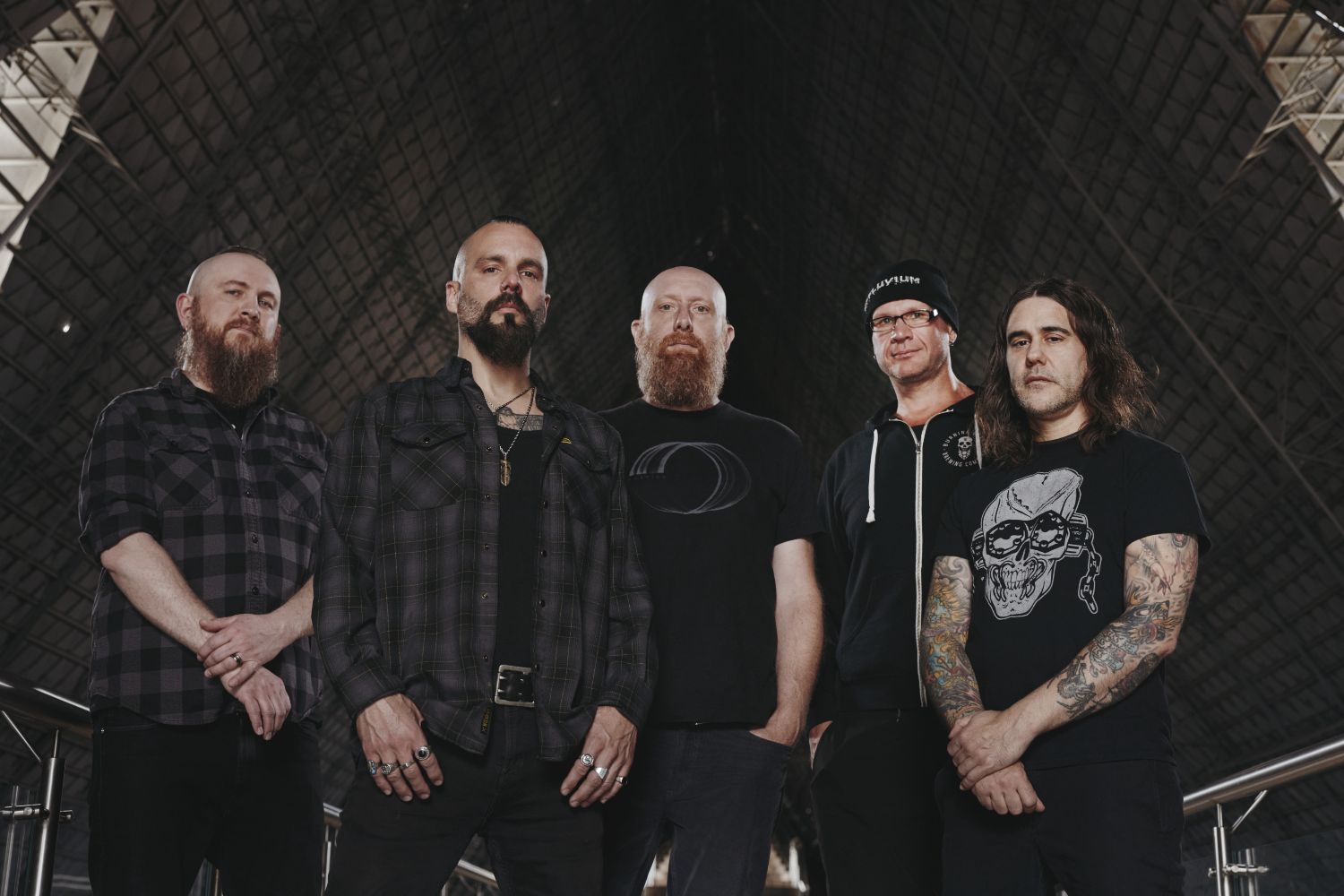
It’s been a couple of years since Killswitch Engage last visited Aotearoa, having previously opened for Iron Maiden in 2024. Returning with Sylosis for their own headline shows, Jesse gives us a glimpse of what the band have in store.
“A much longer set list, a much more diverse set list as well. You’re going to get at least 4 of the new songs, and then a good selection of pretty much every record. We’ve been working really hard on crafting it. And since we have two shows, there’ll be different sets. We’ll be swapping out songs, we get some variety, so the people who are going to both shows won’t see the same set.”
Jesse has always spoken of his love of the energy which those smaller headline shows bring, as they allow him to get closer to the audience and really build that connection. After years on the road, that’s the main thing which makes a show feel special – connection.
“It’s 100% that connection with the audience. That’s the buzz for me, that’s everything. That’s the purpose. You know, it’s one thing to have a career and feel successful, and you know, you can pay your bills. That’s all great, but what keeps me going and what excites me still is that connection, that feeling that something is in the room with us. It’s not just you and me, there’s a feeling. There’s a spiritual energy, something happening that I’ve been chasing, ever since I first started doing this. It’s like that keeps me alive, it fuels me. And that’s a gift, you know, something I don’t take for granted.
With when those shows, you know, have got that energy, I kind of need to be closer to the audience. That’s why I’ll get in the audience, I’ll come down. If there’s a crowd barrier and security, I’m going to come down at some point, usually. I don’t want to paint myself into a corner here, but usually I feel like I have to get in there, and have you sing with me and put my arms around you, and, you know, I love giving people hugs and singing to them. It’s just something about it and knowing there’s a positive impact happening with people because they tell me all the songs have helped them. That’s everything to me.”
The band’s most recent album This Consequence was released back in February 2025, and Jesse has previously described the album as one about finding the strength to walk through the darkness, and learning from it, rather than avoiding it. After more than a year of touring these songs, was the fan reception what he expected, or did the fans show him something which perhaps he didn’t realise was there?
“That’s a good question. Maybe a little but of both. You know, it’s hard for me because I try not to anticipate what a new record is going to do. But, you know, I’m not gonna lie. When we wrote I Believe, that song, I was like ‘this is gonna do something, there’s something to this.’ Even just the lyrics, talking about having hope that things will get better. That message, to me, saved my ass when I was younger. The idea of like, keep the faith, we’re going to be okay.
That song by Bob Marley, 3 Little Birds, ‘Don’t worry about a thing, because every little thing is gonna be alright’, I was like, I want to write a song like that, that someone will hear, and they’ll feel empowered and feel a sense of relief, because we’re going through such strange, dark times. So that to me, again, is all part of it.
But you know, there’s some dark songs on this record, and they’ve been received well, as well. There’s a song called Broken Glass which is about surviving abuse, and people have really connected with that one as well. And every night, I try to speak a little bit about these new songs so people understand where I’m coming from, and so far the reception has been pretty incredible.”
It’s that message of keeping the faith that everything is going to be okay which is one Jesse firmly believes, now more than ever. “We as humans have so much more in common than we do differences. I’ve travelled the world, I’ve met people from all walks of life, and I’m here to tell you the world isn’t as dark as it seems. The darkness just has good PR. The negativity, the violence, the wars, that’s the stuff that social media and mainstream media focus on because that’s what people seem to be obsessed with, and I personally want to use my voice to help change that. Even if it’s just a handful of people here and there, stop buying into this division, it’s there as a means to control us, and it’s divide, rule and conquer, it’s been like that since the dawn of time. And if people realise the power we have when we come together to do something, we can change these rigged systems. We can dismantle them, but it’s just getting people together, to unite.
And I think shows are amazing because that’s what it feels like, when you’re in a room with a bunch of people who are are there to see your band, they’re there for one reason, we’re there for the same reason. That energy is amazing. If we had that bleed out into the rest of our lives, that’s what I’m talking about… and that’s why I think it’ll never go away, even with this AI garbage. You can’t replace passion, you can’t replace compassion. And that’s the one thing live music has.”
In the writing of the album, Jesse has spoken in previous interviews about how reflecting on the pandemic and the upheaval of that time had made him question what he wanted to say, resulting in inviting the band to critique his lyrics and ideas earlier in the process. As a result, some songs underwent significant changes, while others were shelved entirely. “There were entire songs which were thrown away. I think that’s important as an artist, is allowing your creations to die. You know, I think that was the biggest lesson I had to learn. It’s not about me and my ideas, it’s about the collective, it’s about the song itself being good enough. And you know, having four other guys who are all very different, they all have very different tastes. If one person was really bummed on something, it’s gotta go, so that was challenging for sure.
But I think, to be challenged, especially this late in our career, is good because the quality control was high. And it forced me to come up with new ways to say things instead of using some of the cliches that I just default into. There were certain words and ideas that were off the table, couldn’t use them. As Jamie from Hatebreed calls them, Lyric Police, like you can’t use fire stuff, no more fires, we’ve got so much fire in our lyrics.
And then that bled over into the performances too, wanting the vocals to sound desperate, to sound impassioned, to sound pissed off, really, in some songs. And I think that came through. A lot of that was my frustration with trying to write good songs as well. I was like, frustrated, looking at the world and then in my own life being a professional musician, being like ‘do I still have it? I’m a little scared, I don’t still have it,’ and then digging really deep and discovering that yeah, I still have more to say.”
The very title of the album, This Consequence, is suggestive of an idea that actions, decisions and experiences leave consequences behind. Jesse points at the pandemic as being an event which changed him radically. “At first, it just sort of made me shut down and become almost monastic. I just wanted nothing to do with the conflicts that were going on, the ugliness and bitterness of the world, whether it be arguin g over vaccines or police brutality and protesting, and families splitting apart over political ideas. I wanted nothing to do with it.
And then, coming out of it, I realised that well, as an artist, you should address these things. These things need to be talked about. But my gift lies more in the existential, and the spiritual, and the humanity of it all. So to me, taking specific things about politics out of it, and making it more about reaching out to humanity to heal. We have to heal, but the only way we can heal is if we sit with these things which have divided us. If we sit with our anger and our frustration, if we figure out why people are different, why do you think this way, talk about it and have these painful, awkward discussions. And I did that with some people, and it was healing. It was like, it’s not as bad as you think it is.
I think the differences were weaponised against us during that time. And that’s kind of opened my eyes to like, wow, the divisiveness that does on in the upper echelon of politics is they’ll do anything to keep us divided. Anything. Including starting wars. So to me, that’s like the real eye opener for me, is know your enemy, you know, it’s not you and I, it’s not the common folk. It’s these small people up top, the elite, and they’re the real enemy. So targeting them, and reaching out to us as humans going we need to unite and be more loving and compassionate towards each other, and then be like, I see you. I see you up there. So that’s kind of where my brain has been since then, being aware and reading between the lines. Anytime I see a news headline or something on the internet, I’m always suspicious now. I’m reading all around it, I’m pulling from both sides and going all right, what are the facts? What do I think? How do I sit with this? And then, how do I interpret it as an artist to make it where it doesn’t divide any further but stimulates that revolutionary thought of ‘we need to come together’.”
Interspersed with his time in Killswitch Engage, Jesse has also been a cornerstone of the metalcore band Times of Grace, with former KSE guitarist Adam Dutkiewicz. Times of Grace has felt like a different creative space, in a way both more exposed and more introspective, sitting with those difficult emotions.
“I think in a way, it allows for more, I don’t want to say the softer side, but I guess sonically the softer side, but you know Times of Grace still is heavy. It’s just a different kind of heavy. I think topically, it’s just been there for me at the right time. The timing of both of those records was insane. You know, the first one, I was very suicidal, and the second one I was going through a messy divorce. That’s just the right place at the right time, that record sat in front of me and I was able to write about my pain in such a way that, I just don’t know what would come out the same way through Killswitch. Killswitch feels like it’s got to be a little more triumphant, a little more, I don’t know the word.
I guess Times of Grace allows the freedom to put out longer songs, to say more things, to even like, have spoken word poetry in the middle of a song. It just really doesn’t work with Killswitch, so I really love that project. And I’m really proud of that second record. I think we were able to push ourselves into different sounds that even the first record didn’t touch. I look forward to doing more of that style of music where it can be a little more sludgey, or a little more sonically open, or more alternative rock or acoustic, I love all that stuff. And I think some of the best vocal work of my career is on that second record, especially the melodic vocals. I sang my face off on the record!
There were songs where I was having such a hard time in my life, I couldn’t demo them, and it pushed Adam to the forefront to do main vocals on that record because I couldn’t handle it. I was just in a rough spot. But I think that’s a blessing in disguise, because you know, Adam is just, his voice and his lyrics and yeah, everything about what he’s done on those records is brilliant and I love his songs where he takes leads. He’s so good.”
In recent years, Jesse has spoken very openly about his mental health, vulnerability and the importance of compassion – subjects which were often previously pushed to the side, or not really surfaced in music. But how does he feel things have changed in how these topics are talked about now, versus when he was first starting out?
“I think there’s still stigma attached to being vulnerable, but the conversation has happened so much in the past, maybe even decade, that we do have organisations now, especially for musicians, where people recognise that we need to talk about this stuff, especially creative people. A lot of creative people have a specific thing in their brain that makes them creative, but that also gives you some cracks, some flaws. I think a lot of musicians deal with depression, anxiety. You know, that split-brain feeling that a lot of creative people have is what makes us creative.
But, that being said, I’ve talked about it and I’ve had these conversations, and people have had conversations. That conversation needs to continue, because we still have a lot of work to do. We recently lost people to suicide in our community, it happens more than people realise. And that feeling of helplessness, that feeling of like no-one’s ever going to understand what I’m going through, the beauty of it is there’s always somebody who will understand. No matter how dark or how far gone you think you are, somebody is there, even if it’s just a counsellor, somebody that you don’t even know, a stranger. So continue to talk about mental health awareness, suicide prevention, that is always in the forefront of my mind, and any time I run into people who need to speak or need an ear, or shoulder, I’m there and it’s helped me, and saved my life. So pay it forward, and keep this conversation going, and show that vulnerability is a strength, not a weakness.”
Jesse also credits keeping active and being in nature as being important for his mental health. With the upcoming tour, are there any plans to get out and enjoy any of the local scenery? “I’d love to, but it all depends on how bad the jet lag is. I think that’s the main thing, I’m actually going to go a day early just to have a full day to try and adjust. I would love to see things, but most of the time, especially New Zealand for whatever reason, I just feel upside down when I’m there, I’m so tired. Last time we were there, I think I slept an entire day when we got there. The guys went out and did stuff, and I’m like, oh I just can’t even function. So I’m going to go a day early and hopefully I have time to maybe sample some wines, and some food, and see some sites in nature.”
With shows coming up in Auckland and Wellington, there is one thing which he hopes fans will take away from the night, beyond the music itself. “That we need to come together as a community. To help each other out, to be more understanding. To hold compassion in high regard and seek love over hate. I think those are the main things I would love for people to leave our shows with, you know. A sense of hope for the future.”
Killswitch Engage are touring New Zealand and Australia with Sylosis, starting in late October. For more details on the upcoming tour, check out https://voxrebelle.com/news-features/tour-news/killswitch-engage-tour-2026/


